What Actually Happened
Three vendor moves landed inside two weeks and they read as one shift.
On April 20, at Adobe Summit in Las Vegas, Adobe unveiled CX Enterprise — the rebrand of Experience Cloud built around an agentic AI orchestration layer. The pricing announcement was the part that mattered. Adobe said it intends to charge for the new agent suite on outcome-based terms, with fees tied to completed campaigns rather than per-seat licenses or per-token compute. The Information cited a worked example linking fees to the number of advertising campaigns an agent completes for travel and lodging customers. Subscription and consumption pricing stay in place for some existing AI tools, but the new agent suite is the lead product, and the lead product gets paid only when the output ships.
Salesforce already moved in the same direction. The Agentic Enterprise License Agreement (AELA), introduced last fall and now widely cited as the model for 2026 enterprise AI procurement, gives customers unlimited Agentforce, Data 360, and MuleSoft usage for a flat multi-year fee. Customers pay a fixed price; Salesforce takes the upside if the agents produce more output than the contract anticipated. Constellation Research is calling it the standard for enterprise AI procurement this year.
The third leg is the production tool stack. Adobe shipped Premiere 26.0 the same week as Summit, with a dedicated Color Mode, refined Object Masking, and a tighter Firefly Video integration that lets editors generate B-roll, extend shots, and run color adjustments inside the timeline. Frame.io Drive moved Adobe's review workflow to a desktop-sync app. Firefly added an AI Assistant that orchestrates multi-step workflows across Creative Cloud apps. CapCut launched a timeline-free video studio in late March with Seedance 2.0 underneath. Canva folded Cavalry motion design into the free tier and integrated Affinity with DaVinci Resolve. Google's Veo 4 put zero-shot avatar creation, 30-second clips, and 4K consistency on the same shopping list this April, with the formal Google I/O reveal expected May 19.
Stitch the three together. The agentic AI orchestration layer is repricing toward outcomes. The generative video model layer just shipped enough quality to be production-grade. The post-production toolchain has the AI plumbing wired in by default. The variable cost of generating an ad video inside a vendor bundle a B2B SaaS company already pays for just dropped well below the price of commissioning one externally.
Why the Cheap Line Is the Wrong Line
Outcome-based pricing on AI agents is not an academic shift. It is a forecasting change for the marketing leader's spreadsheet. The variable cost of "ship one more video" inside a CX Enterprise plus Agentforce plus Firefly stack is approaching the cost of a single Adobe campaign-completion fee. The variable cost of "commission one more video" through a freelance editor or a project agency is unchanged. For any B2B SaaS marketing leader doing back-of-the-envelope math on Q3 planning, the cheap line stares back from the Slack channel.
Take the bait and the company joins what is already happening across enterprise SaaS marketing. Every direct competitor pulling from the same agentic stack. Generating ad creative against the same Firefly assets. Deploying the same orchestration patterns under different brand wrappers. The content gets produced. It does not get differentiated.
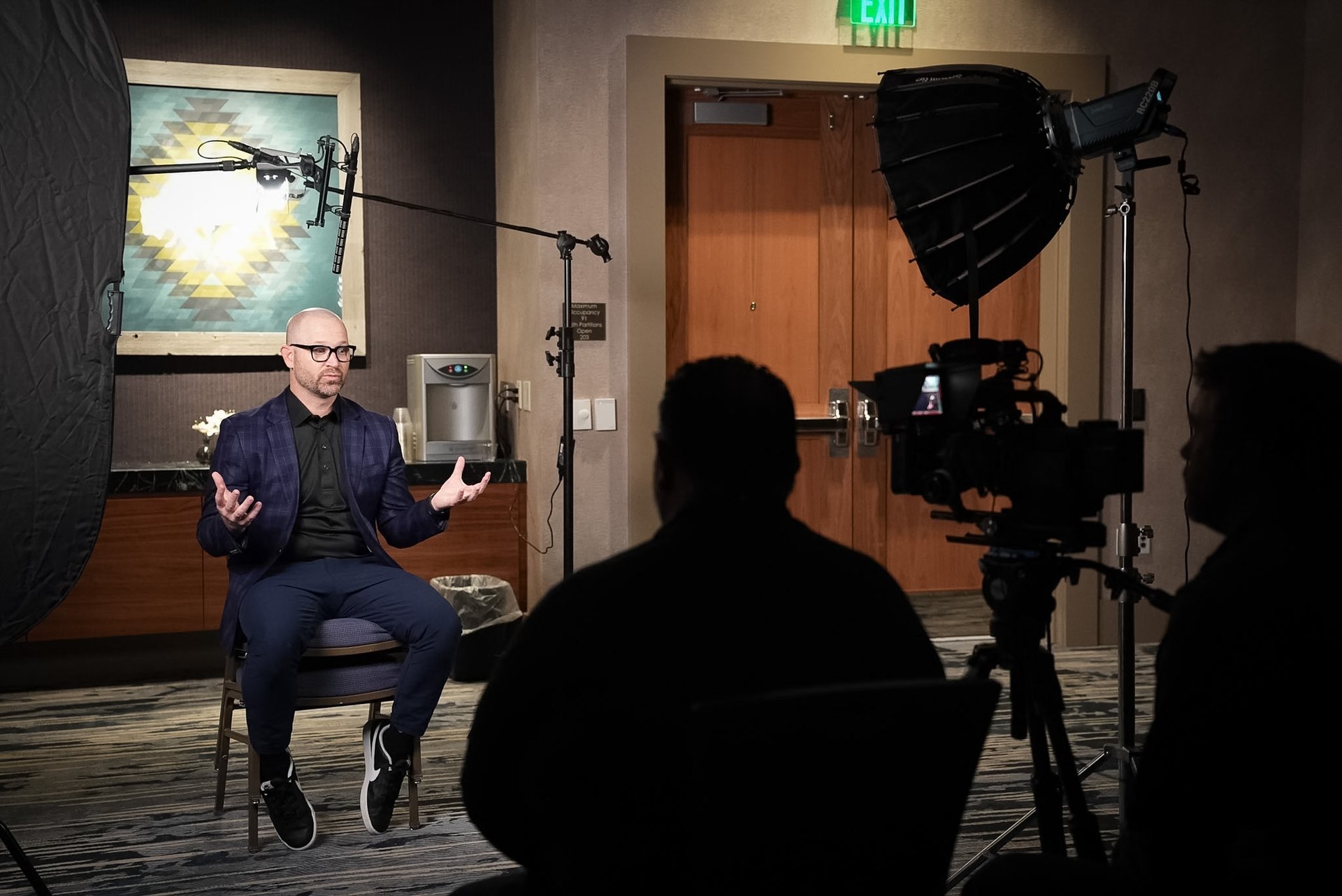
The contrarian thesis is uncomfortable for an operator with a quota. The asset that is structurally hardest to substitute in 2026 is not the one that is hardest to produce. It is the one that captures something an outcome-priced agent cannot generate. A real customer's voice on camera, recorded in their environment, talking about a problem the agent has no first-person knowledge of. A founder explaining the product roadmap on a stage with the audience reaction in the cut. A product team's whiteboard session captured live. None of those are reproducible by an agent reading a brand book and a campaign brief. All of them get harder to differentiate the moment a marketing team relies on the cheap stack to fill the calendar.
Branding has had a name for this for thirty years. It is the substitution risk. The line items that are easiest to substitute are the first to get cut when the budget tightens, and they produce the lowest brand premium when the budget holds. Outcome-based pricing on AI agents just made the substitution map for B2B SaaS video much sharper.
The Data
Two pulls from our book and one from the third-party picture, framed honestly.
First, our internal Q1 2026 retainer audit across roughly twenty active SaaS engagements. The asset categories the customer-facing teams cite most often as "the one piece of content that closed the deal" are not the production-heavy ones. They are customer-voice cuts, founder-led explainers, on-stage event capture, and recorded technical conversations. We log this on every engagement debrief — the asset the AE attributes to a closed-won, captured at the moment of the call. Across the audit, captured-human assets accounted for roughly 70% of those callouts and roughly 30% of total production hours. The ratio is the point. The minority of our production hours produces the majority of attribution moments.
Second, our 2026 production time-study from the same audit. The cost per distributable cut on a captured-shoot day, after editing, lands at roughly $180 per ready-to-ship asset across our retainer book — long-form piece, three-to-five vertical cuts, and the email asset all coming from one capture session. Cost per cut on agent-generated content, even at outcome-based pricing in the low double digits per campaign, looks lower per unit on the spreadsheet. The math flips when you weight by attributed pipeline. Our internal yardstick: a captured cut produces roughly four times the qualified-meeting activity of an equivalently positioned agent-generated cut. We recommend marketing leaders run their own version of that ratio rather than trust ours.
Third party. Wistia's 2026 State of Video reports vertical 1080×1920 uploads up 24% year over year and human-creator content showing materially higher engagement than AI-generated stock-style assets across its 13 million-video sample. Sprout Social's 2026 LinkedIn algorithm coverage confirms native video runs roughly 5× the feed reach of static, with personal profiles receiving 65% of feed allocation versus 5% for company pages. The structural distribution advantage sits with content that puts a real human in the cut, not with the orchestrated brand asset. Gartner's most recent CMO Spend benchmark has flat overall budgets and 39% of CMOs already planning to cut agency budgets in 2026. The pressure is real. The substitution map is the question.
The Counter-Argument, Steelmanned
The strongest case against this thesis is operational. A B2B SaaS marketing leader running flat to down on headcount in Q2 2026 cannot reasonably plan a content roadmap that depends on shoot days, captured guests, and locked editing turnarounds. The agentic stack is not just cheaper per output. It is cheaper to operate. Adobe's outcome-based pricing and Salesforce's flat AELA remove the procurement friction that used to govern AI agents inside the enterprise contract. Firefly Video plus an agent that orchestrates the campaign means a marketing manager can ship five videos in the time it took to scope one, and the boss does not care if the assets look like every competitor's because the boss is measuring volume on a dashboard.
That is a fair read of the operational reality, and it is mostly correct in the short run. The problem is what it looks like at month nine.
A B2B SaaS marketing leader who runs the agent-generated playbook for a quarter ships volume and meets the dashboard target. The same leader at month nine notices three things that do not show up on the dashboard. Brand search volume flatlines while paid spend rises, because there is no captured-content moment that gives the brand identity outside the funnel. Customer voices, the asset the sales team actually shares in late-stage deals, are not in the library, because nobody captured them. The competitor down the road shipped 80% of the same agent-generated content from the same stack, and the only thing that distinguishes the two brands in the buyer's head is the price tag.
The steelmanned counter holds for a quarter. The substitution risk catches up after that. The marketing leader who plans on twelve months protects the captured line. The one who plans on the next dashboard does not.
What to Do Monday
Run the substitution map on your own catalog first. Walk through the last twelve months of distributed video and tag each asset honestly. Agent-generatable today. Agent-generatable in twelve months. Or capture-required. The third bucket is the budget you protect. The first two are the budget that is going to compete on price.
Audit the AI-tax line next. Pull the renewal quotes on Creative Cloud, the Agentforce or AELA contract negotiation, the Firefly credit consumption forecast, and the upcoming CX Enterprise outcome-pricing model. Across our retainer book the AI-tax aggregate has crept past 20% of the marketing software line in the last twelve months. That is real money getting consolidated into vendor bundles. Treat it as a procurement question first, a content question second.
Lock the capture cadence before the budget review, not after it. The captured-content line is structurally indefensible if it is project-shaped — a one-off shoot in March that the team has to re-justify in June. The same line is structurally defensible if it is retainer-shaped — a recurring shoot day, a recurring guest schedule, a recurring deliverable count. Convert the cadence before the CFO walks into the Q3 review, because the conversation goes differently when the deliverables are recurring versus when they are not.
Do not throw the AI stack overboard. Outcome-based agentic AI is excellent for the asset categories where substitution risk is low because the output is supposed to be commodity. Variant testing on paid social creatives. Copy localization. Tier-three blog assets. Sales-enablement pages. Use the cheap stack to do the cheap work. Stop letting it produce the brand work.
If the in-house team cannot run capture and the agent stack in parallel, partner the part you cannot run. Captured-content production is operationally heavy in a way that a marketing team with three open headcount slots cannot absorb. Outsource the heavy part. Run the cheap part inside the bundle you already pay for. The mistake is doing it the other way.
The B2B SaaS marketing teams that lose 2026 will be the ones that bought the cheap path because the spreadsheet said so. The ones that win will be the ones who read the substitution map first and built the content stack so the structurally defensible work was already in flight when the AI tax landed on the renewal.