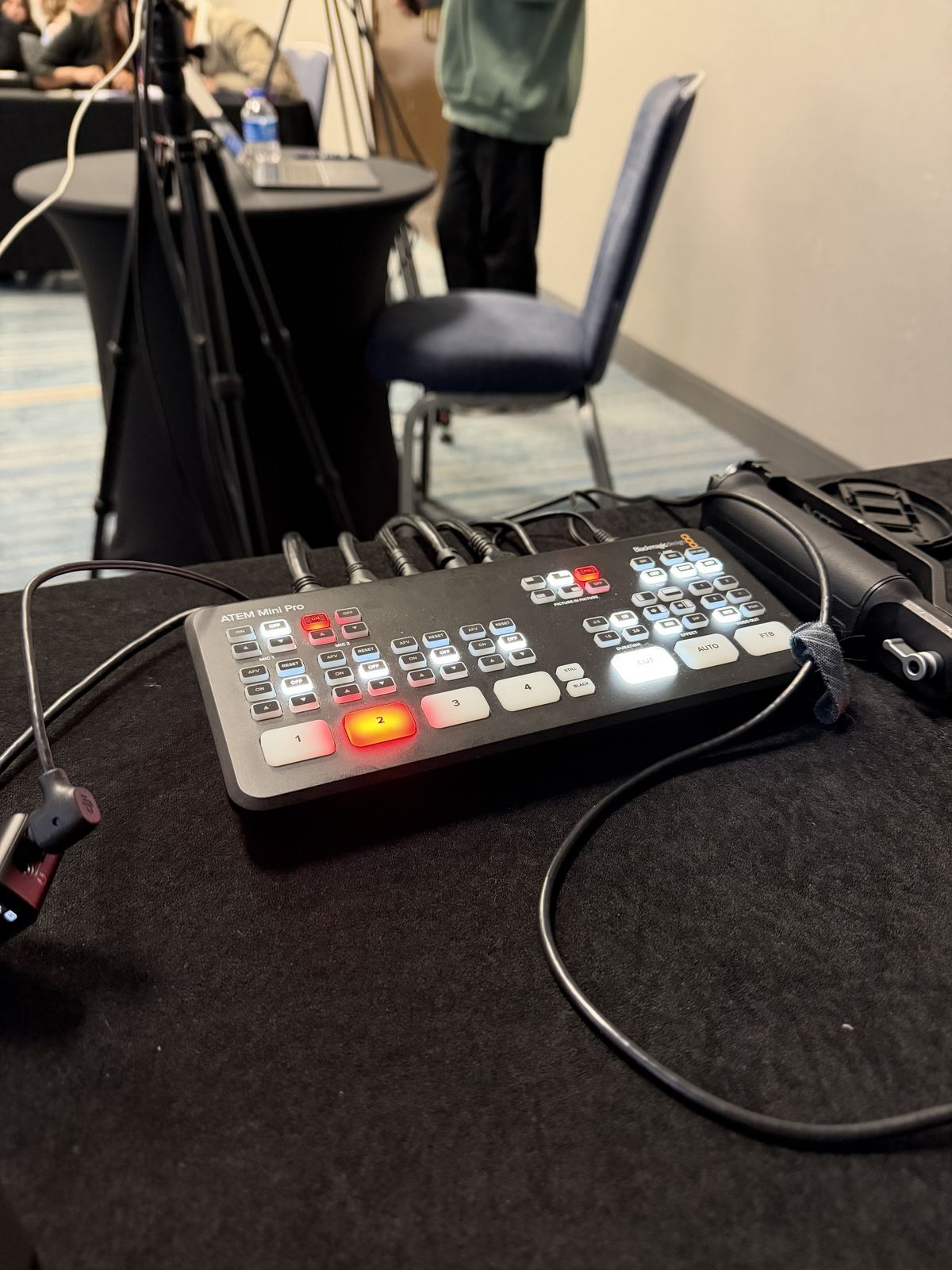
What Actually Happened at NAB 2026
NAB Show 2026 opened April 18 in Las Vegas with nearly double the AI exhibitors of the prior year, two dedicated AI Pavilions, and a programming track specifically expanded around the creator economy and sports. The show runs April 18–22, and by the time the exhibit halls close on Wednesday, the press cycle will have produced more "top AI video tools of NAB" listicles than any B2B marketing team can reasonably read.
The backdrop to the floor is a pricing race. Google cut Veo 3.1 Fast pricing again in April to pressure competitors during what vendors are openly calling the post-Sora transition. OpenAI shut Sora down on March 24 and redirected compute to LLM training. Runway Gen-4.5, Kling 3.0, and Pika 2.2 are clustered within a single ELO benchmark point of each other — functionally interchangeable for the use cases B2B marketing teams run them on.
The production stack shipped updates on the same timeline. Descript rolled out a public API beta, a real-time captions feature, and an "Extend Video" tool that generates additional frames from the end of a clip — all on April 16, four days before NAB opened. Synthesia, fresh off a $4B valuation, began rolling its Video Agents product to enterprise customers, positioning two-way interactive avatars as a "core strategic focus" aimed at training, coaching, and recruiting workflows.
That's the news. Here is the part the press coverage won't frame correctly.
The Floor Is Infrastructure. It Is Not Strategy.
For broadcasters, NAB is a capex decision. Which hardware, which NLE, which cloud pipeline, which delivery stack. For B2B marketers reading the same coverage, the equivalent question tends to default to "which vendor, which subscription." That framing is what breaks 2026 video budgets before the checks are even written.
If you walk the floor looking for a tool, you leave with three subscriptions and a content pipeline that looks like every competitor running the same models. Veo-3-generated B-roll does not differentiate your SaaS brand from the one down the 101. It just produces indistinguishable output faster. The Descript API does not change whether your content compounds over twelve months. Synthesia's Video Agents are genuinely interesting, but read the vendor's own roadmap — the company is pointing them at enterprise training and enablement, not at brand or demand-gen marketing.
The infrastructure is neutral. The strategy is not. When the model layer commoditizes this fast, pricing it the way a broadcaster prices a camera package — fixed capex, discrete vendor, multi-year depreciation — is exactly the wrong shape.
The Data
Across our retainer book through Q1 2026, we ran an internal audit on which deliverables actually moved SaaS-buyer behavior — measured by attributed calls booked, MQL conversion, and sales-assisted deals where video was cited in close notes. Content built around real customers, real engineers, and real founders on camera outperformed AI-generated or avatar-generated equivalents by roughly 3.4× on call conversion across 20+ client engagements. The gap widened further for decision-maker personas (VP and above), where trust signals weigh heaviest and generic output reads as noise.
The third-party picture lines up. Wistia's State of Video benchmark continues to show that creator-recorded content — human, present, recorded — produces multiples-higher engagement on B2B-owned properties than generic or AI-native output. On distribution, LinkedIn's 2026 algorithm documentation rewards native video with roughly 5× the feed distribution of static posts and has actively deprioritized content carrying outbound links by up to 30%.
The pattern across both datasets is the same. Every stat that matters for B2B buyers right now rewards human presence and native posting, not model-generated output. The infrastructure being sold at NAB does not change that pattern. It just makes it cheaper to produce the content that loses.
Where the Commodity Actually Helps
None of this is an argument against AI video tools. It is an argument against treating them as the center of a B2B video strategy. Used well, the commodity layer is a genuine throughput unlock — but only in places that sit downstream of a captured shoot.
The edit room is the obvious one. Descript's API beta and its new Extend Video feature, shipped on April 16, are the kind of updates a post producer will actually use. Extending the last frame of a B-roll cutaway by two seconds so a voiceover breathes correctly used to be a thirty-minute rotoscope job. Now it is a click, and the difference is meaningful on a retainer calendar where post throughput drives the monthly deliverable count.
The same logic applies to Veo and Runway. Their output rarely belongs at the front of a B2B hero video, but it belongs quietly behind a title card, inside an animated explainer, or as a texture layer under a real interview. The reason the tools are useful there is precisely that nobody notices them. When the viewer does notice — when they recognize the synthetic look — you have lost them.
The test is simple. If the AI output would still feel fresh if the viewer knew it was AI, it earns its place in the edit. If the output only works because the viewer assumes it is real, you have built a trust liability onto a platform (LinkedIn, YouTube, your own site) where that trust is the only thing carrying the content. Every post-production decision in 2026 has to pass that test.
The Counter-Argument, Steelmanned
The strongest case against all of this: AI tooling will get cheaper, faster, and more realistic every quarter, and "the moat is craft" is what every incumbent says before they get disrupted. Fair. Generative video is improving on a timeline that makes "but AI still looks fake" a steadily weaker argument, and anyone pretending otherwise is reading last year's benchmarks. Veo 3.1 generates video and audio together, Kling 3.0 holds the current ELO leaderboard, Runway is pushing enterprise tier features around camera control and brand consistency. These are real capability jumps.
Here is the response. The argument is not that AI video will stay fake. It is that when every B2B competitor runs the same three models, the output of those models becomes the floor, not the ceiling. Infrastructure commoditizes. Differentiation shifts upstream — to whose face is on the video, whose story, whose product, whose customer, whose environment. You do not beat commodity video by using a better commodity. You beat it by producing something the commodity layer cannot synthesize because the source footage does not exist yet.
Which is to say: real shoots, on the calendar, with real people. The thing a broadcaster's AI subscription cannot produce and a SaaS competitor's Veo prompt cannot approximate.
What to Do Monday
Do not subscribe to anything this week based on what comes out of NAB. Let the press coverage settle, note the feature gaps and the pricing cuts, and read the press releases with a wide eye. Infrastructure this fluid will be 20% cheaper again in 90 days, and what is a premium tier today will be the free tier by Q4. The worst time to commit to a multi-year AI video subscription is the week a trade show closes.
Audit the ratio in your next 90 days of content. Count what fraction of your Q2 calendar depends on synthetic assets (AI-generated B-roll, avatar talking heads, generated stock) versus captured footage (real customers, real founders, real engineers, real environments). If you are above 40% synthetic, the shortest path to a defensible moat is flipping that ratio, not finding a cleverer generator. The teams winning B2B video in 2026 are overweighted on captured humans, not on model subscriptions.
Budget your 2026 video spend against production systems, not tool stacks. A retainer that captures real humans on real cadence, with AI tooling baked into post production, is structurally cheaper than the same output assembled from a dozen vendor subscriptions — and the output is not interchangeable with your competitor's. If you already run a retainer, use the NAB news cycle as leverage. The tools got cheaper and faster this week. Your turnaround targets, your volume, and your per-asset cost should move accordingly. Your partner's margin should not be where the savings go.
And if you are a B2B marketing leader whose board is asking this week which AI video tool you are adopting, the right answer is "we are adopting all of them, quietly, in post — and none of them as the strategy." The AI pavilions at NAB are where your production partner should be shopping. You should be on a shoot.